Industrial Development

Release date:2025-12-17

Promotion Strategy

Against the background of rapid global industrial changes, ITRI plays a crucial role as both a "lever" and a "bridge". In response to industrial environmental trends, ITRI provides comprehensive R&D collaboration and consulting services, including commissioned development of new technologies and products, small-scale pilot production, process improvement, calibration and measurement, metrology standards, as well as technology transfer and intellectual property value-added services. By integrating domestic and international resources through diversified cooperation models, the Institute assists enterprises in overcoming technological bottlenecks and enhancing competitiveness. ITRI has simultaneously established the Tron Future Tech and an incubation mechanism to actively promote innovation, research and development as well as new business incubation. This accelerates the adoption of technologies and is dedicated to creating an industrial ecosystem with both flexibility and resilience. This approach responds to the uncertainties and diverse demands of the global market, driving Taiwan's industries toward sustainable development and realizing a future vision of technology-driven social progress.


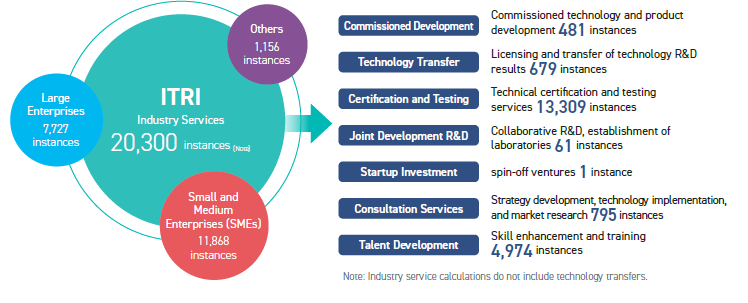
Through technology transfer and application of research achievements, ITRI has successfully transformed its R&D capabilities into industrial value and promoted the upgrading and transformation of domestic enterprises. The Institute develops key technologies to support Taiwan in achieving its net-zero emissions target based on the "2035 Technology Strategy & Roadmap." Simultaneously, ITRI adopts a collaborative R&D model and works closely with domestic and international enterprises and research institutions to promote industrial innovation; it supports startup teams, advances technology commercialization, and expands the impact of R&D results. Through corporate consulting and talent training services, the Institute deepens technology application and strengthens industrial resilience. These achievements have not only driven industrial upgrading and social development but also enhanced Taiwan's global competitiveness and helped the country become a vital force in driving industrial innovation.

Social Benefits_1

IP Innovation Week: Innovative Protection Umbrella Helps Industrial Deployment

The Institute's "IP Week" has been held for 30 years, and the event has been continuously dedicated to promoting the concept of intellectual property, enhancing intellectual property cultural literacy throughout the Institute, and assisting Taiwan's industries in improving their intellectual property competitiveness. Amid the global wave of technological innovation, the "IP Innovation Week" in 2024 was launched with innovative elements, under the theme of "Innovative Intellectual Property and Sustainable Future."

The event brought together 28 distinguished experts from industry, government, academia, and research sectors to share practical experiences in the application of intellectual property and innovative sustainable development. The goal is to assist enterprises and startup teams in proactively planning their intellectual property strategies, effectively utilizing resources, and seizing business opportunities. The event attracted a total of 2,125 participants, with industry attendees representing nearly 50 organizations across diverse fields including smart sensing, optoelectronics, automotive electronics, biotechnology, and intellectual property. ITRI continuously injects vitality into Taiwan's sustainable innovation ecosystem through the "IP Innovation Week."


Social Benefits_2

3D-Printed Oral and Jaw Prosthesis Technology

The 3D-printed oral and jaw prosthesis technology integrates computer-aided design and additive manufacturing to produce customized titanium implants that assist oral cancer patients in jawbone reconstruction, restoring both masticatory function and facial appearance. Multiple clinical trials have been completed, demonstrating excellent adaptability and safety. The technology continues to advance through collaborations with hospitals and industry partners, expanding its applications to dental and oral surgical materials, thereby driving innovation and upgrading in the medical device industry.

Environmental (E)

Social (S)

Governance (G)

Reducing carbon emissions during the manufacturing process of oral and jaw prostheses, as well as minimizing the generation of substantial waste materials

Improving the appearance and masticatory function of oral cancer patients, bringing new hope to oral and jaw reconstructive surgery

Solving patients' poor appearance and chewing function and reducing medical costs and the resulting social costs


Solutions

The Institute, in collaboration with Kaohsiung Veterans General Hospital, has for the first time applied an additive manufactured medical device to oral and jaw prosthetic products. By integrating commercially available dental implants and abutment teeth, we are able to reconstruct mandible defects. Animal experiments and human clinical trials have been conducted to enable patients undergoing mandible resection surgery to restore function and facial appearance, thereby improving their quality of life.

Technology Application

²  Using additive manufacturing (AM) to design appropriate customized facial bone titanium prostheses combined with buried dental implant bodies.

²  Integrating computer-aided design (CAD) and AM technology to print out customized titanium implants for reconstructing mandibular defects, aiming to achieve structural, aesthetic, and functional objectives.

Achievements

²  In December 2018, a Factory of Intelligent Additive Manufacturing (FoiAM) was established in the Lujhu Science Park. In 2024, based on this factory, the ecosystem collaboration will be expanded to develop technologies for dental and oral surgery medical devices.

²  In March 2019, a Memorandum of Understanding (MOU) was signed with Kaohsiung Veterans General Hospital, Global Alliance Global Technology Co., Ltd., and the Southern Taiwan Science Park Bureau. In October of the same year, the first nationwide clinical trial was conducted.

²  Among the nine completed clinical cases, none of the implants exhibited loosening. More than half of the patients were able to begin chewing food, ensuring nutritional intake while maintaining symmetrical appearance. Currently, efforts are ongoing to improve implant design and enhance biocompatibility, with the expectation of further expanding human application in the future to accelerate the commercialization and practical use of this medical device.

Social Benefits_3

Toner Recycling and Reuse

The toner recycling and reuse technology combines powder surface property analysis with dispersant design to successfully convert complex mixed waste toner into highly stable, eco-friendly, and non-toxic water-based color slurry and latex paints. The products have obtained GRS certification and been commercialized. This technology overcomes key challenges in toner recycling and extends its application to other powder waste materials such as fly ash, thereby promoting the circular economy and carbon reduction.

Environmental (E)

Social (S)

Governance (G)

Achieve 100% recycling of used toner cartridges, preventing them from being sent to incinerators or landfills

Recyclable, reusable and complex waste toners are pioneers of new toner recycling technologies and industries, which create five new employment opportunities (Note)

Integrating the upstream recycling industry, midstream color slurry/masterbatch, and downstream coatings/watercolors/fibers to form a circular economy industrial chain, facilitating investments and achieving a production value exceeding NT$200 million

Note: The addition of five employees pertains to a single vendor. If this initiative is expanded to other similar companies, it has the potential to boost employment growth and training opportunities significantly.


Solutions

Fujifilm, in collaboration with the Material and Chemical Research Laboratories (MCL) of ITRI, jointly developed a project leveraging ITRI's strong foundation in powder surface characterization and dispersion techniques. They successfully transformed a variety of hydrophobic toners into an environmentally friendly aqueous black color slurry, which was further formulated into water-based latex paint. The product has obtained multiple CNS certifications and has been commercialized, marking an important milestone in the full-machine recycling process.

Technology Application

²  Through the analysis of powder surface characteristics and the integration of the Database of Powder Dispersion, precise dispersant structures are designed to ensure that mixed waste carbon powders, which are diverse in type and complex in composition, achieve optimal dispersion. This process enables the preparation of highly stable, environmentally friendly, and non-toxic water-based color slurry.

²  Scalable and stable process parameters are established to convert mixed waste carbon powder into water-based color slurry, ensuring consistent color density across different batches and types of waste carbon powder, thereby achieving high-quality and stable latex paint products.

Achievements

²  Recycled toner remanufactured water-based black slurry has obtained Global Recycled Standard (GRS) certification (Certificate No.: 1258777)

²  Recycled toner powder remanufactured latex paint has been commercialized and already has sales records.

²  The recycled toner remanufactured latex paint has undergone on-site certification for over two years, and its good appearance has been maintained.

²  Fujifilm was honored with the Golden Quality Award, the highest distinction for outstanding resource recycling enterprises, by the Ministry of Environment in 2023 for this development project. The achievement also attracted attention and coverage from multiple media outlets, including TVBS, Chinese Television System (CTS), Formosa Television (FTV) News, and Business Today.

Social Benefits_4.1

Low-Carbon Full Recycling of Reclaimed Asphalt Pavement

The low-carbon full recycling technology for reclaimed asphalt pavement utilizes an innovative hydrothermal process combined with bio–heavy-oil-degrading bacterial agents to efficiently separate recycled asphalt pavements into new aggregates and asphalt sand. When used with asphalt rejuvenators, it achieves 100% reuse. This technology overcomes traditional recycling bottlenecks, advances resource circulation and carbon reduction in the asphalt industry, and contributes to industrial upgrading and sustainable development.

Environmental (E)

Social (S)

Governance (G)

Full-cycle recycling of recycled asphalt pavement, effectively reducing the extraction of natural sand and gravel as well as the use of fossil asphalt

Recycled pavement roads possess anti-rutting characteristics, enhancing road durability, improving public safety, and increasing driving comfort

Development and integration with multiple technologies achieve efficient resource utilization. This technology promotes industrial transformation and upgrading and enhances corporate competitiveness and carbon reduction benefits


Solutions

The Institute's asphalt rejuvenator product can reuse 40% of recycled asphalt pavement (the regulatory usage limit), enabling the construction of asphalt rejuvenator pavements that balance rigidity and flexibility for enhanced driving safety.

Due to 60% of the recycled asphalt pavement being non-recyclable, the Institute has developed an innovative green separation technology for recycled asphalt pavement and aggregate. This technology restores the recycled asphalt pavement to aggregate as if it were new, meeting national grading standards and enabling its reshaping, restoration, and reuse, which achieves the goal of 100% recycling of recycled asphalt pavement.

Technology Application

²  ITRI has developed a green separation and recycling process that uses an innovative hydrothermal asphalt stripping technology combined with biological agents to pre-treat the reclaimed asphalt pavement using heavy-oil degradation bacterial agents. Water is then used as a carrier for heating and stirring to accelerate separation (the water is fully recyclable). This effectively reduces the recycled asphalt pavement to 70% new gravel and 30% asphalt sand. Combined with the asphalt regeneration agent developed by the Institute, 100% of the recycled asphalt pavement can be used in road paving, achieving zero-waste and complete recycling.

Achievements

²  ITRI cooperates with Lien Yueh Corporation to jointly establish the country's first demonstration plant for reclaimed asphalt pavement, with an annual processing capacity of 80,000 metric tons. The project is expected to be completed in 2025, leading the transformation and upgrading of the asphalt industry.

²  This innovative technology is recognized by the Taiwan Asphalt Industrial Association, with positive prospects for the development of full-cycle recycled asphalt pavement technology.

²  Extensive media coverage has attracted significant attention from the industry and project management authorities, creating a favorable opportunity for the Institute's technology promotion.

Social Benefits_5

Diversified Regeneration of Pineapple Leaf Agricultural By-Products

The diversified regeneration of pineapple leaf agricultural by-products integrates raw material sorting, spectral detection, and enzymatic decomposition for micronization, precisely analyzing leaf residue structures and efficiently converting them into functional cellulose, UV-absorbing additives, and antioxidant extracts. This innovation overcomes the low-efficiency limitations of traditional agricultural waste recycling, creates high-value green products, and has been recognized with the French Sustainable Beauty Awards.

Environmental (E)

Social (S)

Governance (G)

Reducing the accumulation and burning of agricultural by-products, decreasing soil pollution and greenhouse gas emissions, improving land and air quality, and reducing waste by 90%.

Revitalizing the rural economy to promote investment in new industries

Assisting in the integration of the supply chain, driving new market development and industry transformation; the innovating materials have been awarded the Sustainable Ingredient Award from France.


Solutions

In response to the global trend of green and environmentally friendly products and consumer demand, the Institute is committed to developing innovative raw material technologies for sustainable personal care products. By linking the locally sourced unique pineapple leaf residue, ITRI has established a sterilization, pulverization, and drying process for active preservation. We have developed zero-waste, skin-friendly, and antioxidant-functional skin care raw materials, as well as functional masterbatches and containers. This initiative further aims to build a green raw material-based supply chain for the consumer goods industry.

Technology Application

²  Integrating the production sites to establish raw material sorting specifications, physical property evaluation, spectral analysis, and the ingredient identification system. This will help farmers accurately identify the structural and compositional characteristics of pineapple leaf residue to enhance quality stability.

²  Integrating enzyme-assisted decomposition and micronization reaction technologies to achieve the production of high-value products such as functional cellulose, UV-absorbing additives, and antioxidant active extracts, meeting the diverse market demand for green consumer chemicals.

²  Precisely addressing the issues of low efficiency and limited utilized volume in the traditional agricultural waste recycling process, assisting the industry chain in transitioning towards a low-carbon, circular economy, and creating more competitive green product value.

Achievements

²  Pineapple leaf skin-friendly powder material becomes the first circular material technology to win the Sustainable Beauty Awards of France.

²  Pineapple leaf recycled cosmetic ingredients, in collaboration with Kiss Me Cosmetics and Imei Chemical Enterprise Ltd., assisted the Taiwan Pavilion, led by the Taiwan Beauty Valley industry innovation alliance, to stand out among all national pavilions, and was awarded the 2024 Local Initiative Gold Award.


Social Benefits_6

Low-Carbon Concrete Process Integrated with Dynamic Intelligent Computation

The low-carbon concrete process integrates an AI-based intelligent computing platform, overcoming the traditional machine learning limitation of requiring large datasets. Under limited experimental conditions, it achieves over 80% accuracy in mix design prediction and is adaptable to recycled materials from different plants. This technology can reduce carbon emissions by 70–90%, won the 2024 R&D 100 Awards, and promotes resource circulation and low-carbon sustainable development in the construction materials industry.

Environmental (E)

Social (S)

Governance (G)

Reducing carbon emissions by 70-90%

Gathering relevant AI talents to invest in the intelligent development of the circular economy industry chain.

Assisting in the integration of related industries, driving new market development and industry transformation, and honored with the "2024 R&D 100 Awards."


Solutions

This technology enables the reaction of inorganic resource materials at room temperature to produce polymer materials with mechanical strength. By integrating the AI Intelligent Platform, it enhances the proportion of recycled materials in products and controls quality, promoting the effective recycling and regeneration of resources as reliable construction materials.

Technology Application

²  AI Platform Formula Prediction Accuracy Exceeds 80%: Using traditional machine learning methods requires the introduction of more than 100 sets of preliminary research data; otherwise, the prediction accuracy is approximately 50%, consuming a significant amount of time and resources for experimental testing. This technology, combined with calculations based on Materials Theory, can greatly improve computational efficiency with a limited number of experimental sets and increase the formula prediction accuracy to over 80%.

²  This platform's technology is based on data derived from fundamental material theory analysis and is not limited by the source material formulations. It can utilize recycled raw materials from different factory sites.

Achievements

²  Under the trend of achieving net-zero carbon emissions, industrial by-products and resource materials may go through circular regeneration through low-carbon processes. The concrete and construction-related industries can thus obtain clinker cement substitute materials that are low-cost, have a low carbon footprint, and are of reliable quality. In response to the ongoing demand for the expansion of domestic high-tech factories and renewable energy facilities, as well as the construction industry's increasing emphasis on low-carbon green buildings and safety, this technology offers a comprehensive solution.

²  Preliminary efforts have been made to promote cooperation along the upstream and downstream industrial chains for the demonstration production of carriers such as drainage manholes, wave-dissipating blocks, and sound barrier walls.

²  Winning the 2024 R&D 100 Awards


Social Benefits_7

AI-Driven Drone Bridge Inspection System

The AI-powered drone bridge inspection system integrates smart waypoint generation, automated inspections, real-time image transmission, and AI-based anomaly rapid screening. It overcomes the positioning limitations in weak GNSS environments, enabling efficient under-bridge inspections and fully automated record management. This technology reduces labor costs by 40%, improves inspection quality and safety, and drives innovative applications in smart transportation infrastructure maintenance.

Social (S)

Governance (G)

Enhancing the efficiency of bridge inspection and maintenance, and the safety of traffic facilities

Reducing labor inspection costs by 40% and improving bridge inspection quality; operational costs are 60% of the traditional bridge inspection methods, significantly reducing operational risks.


Solutions

The Information and Communications Research Laboratories (ICL) of ITRI has developed the country's first fully automated, highly secure, smart, and easily manageable AI Intelligent Drone Bridge Inspection System. Utilizing drones to control and manage the system, it conducts fully automated bridge inspections under safety standard operating procedures (SOPs). Once the mission is set, the drone can take off with a single command to automatically inspect bearings, piers, river channels, bridge undersides, and steel bridges. The Drone Intelligent Management Platform records inspection images and employs AI for rapid screening of deteriorated components and process analysis, accumulating big data of inspection records to complete the inspection history. Inspection efficiency is thus enhanced through smart technology, precise image analysis, and detailed inspection records to support environmental sustainability.

Technology Application

²  The AI drone bridge inspection system offers smart waypoint generation, one-click automatic takeoff and inspection, real-time image transmission, cloud-based digital management, AI classification and rapid screening, as well as anomaly alerts. It is capable of efficient positioning and computation even in environments with weak Global Navigation Satellite System (GNSS) signals and completes under-bridge inspection tasks.

²  Drones can automatically inspect based on waypoints, transmit images in real-time for multi-point simultaneous viewing, automatically record and classify images in real-time, and perform component image analysis, comparison, image annotation, and classification, thereby completing the bridge inspection records.

²  The system control prioritizes safety as the primary objective. It can establish no-fly zones around the bridge for beyond-visual-line-of-sight flight, with full automatic flight data monitoring throughout the process and a safe return mechanism.

Achievements

²  The fully automated unmanned aerial vehicle (UAV) facility inspection system has been implemented across three major transportation networks (Taiwan High Speed Rail, provincial highways, and MRT systems), covering intelligent inspections for a total of 13 bridges across six counties and cities. This initiative has successfully supported companies such as Wistron, Taiwan High Speed Rail, Liming Engineering Consultants, and C-Link Technology in entering the UAV intelligent transportation service market and enhancing the resilience of the industry supply chain.

²  This system has helped companies like Liming Engineering Consultants and Taiwan High Speed Rail Corp. establish professional drone service teams and inspection and maintenance capabilities, reducing manual inspection costs by 40% and improving bridge inspection quality.


Social Benefits_8

Kilowatt-Level Chip Cooling and AI Server System Cooling Solutions

The kilowatt-level chip cooling and AI server system cooling solutions overcome the thermal management bottlenecks of high-power chips and megawatt-class servers. By combining enhanced chip heat transfer with low-energy consumption heat exchange technology, it achieves up to 90% savings in cooling electricity and a 20–30% reduction in carbon emissions. Collaborating with international leaders such as AMD, the solution delivers a globally competitive, integrated cooling system.

Environmental (E)

Social (S)

Governance (G)

Reducing server equipment cooling electricity consumption by 90%; decreasing system carbon emissions by 20%-30%

Establishing the Southern Taiwan R&D Center to gather relevant talents from southern Taiwan and increase employment opportunities.

Integrating domestic upstream and downstream industries in response to the substantial demand for AI applications, invigorating and strengthening domestic competitiveness; based in Taiwan, serving the world.


Solutions

Traditional server systems use air cooling methods and are now facing dual application bottlenecks caused by heat dissipation and high power consumption from high-power AI chips and high-power AI servers. Therefore, the development of thousand-watt class high-power chip cooling technology has been undertaken. From the perspective of general system cooling, the approach extends from the chip level to the entire AI server system, providing a comprehensive cooling solution that combines both cooling efficiency and energy savings. Compared to traditional cooling technologies, this system can save over 90% of the energy consumption used for cooling server equipment, while simultaneously reducing the system's carbon emissions by 20% to 30%.

Technology Application

²  Developing chip thermal conduction enhancement technology to break through the heat dissipation bottleneck of high-power chips rated above 1,000 watts.

²  Low-energy consumption heat exchange technology provides a low-power cooling solution for 10,000-watt class servers.

²  The chip system analysis technology provides analysis and design services to the industry to support industrial applications.

Achievements

²  Collaborating with the domestic company I-Chiun Precision Industry, focusing on the development of chip thermal conduction enhancement technology to improve heat dissipation efficiency and chip operational stability.

²  Collaborating with the international industry leader AMD to develop low-energy consumption heat exchange technology, effectively cooling server systems with power levels exceeding 10,000 watts through high-efficiency distributed heat dissipation capabilities.

²  In collaboration with international enterprise AMD as well as domestic memory manufacturer Winbond Electronics, passive components company Walsin Technology, solid-state drive company Phison Electronics, AEWIN Technologies, Compal Electronics, I-Chiun Precision Industry, and Fusheng Precision, a joint Advanced AI Server System Validation Project has been undertaken.

Social Benefits_9

Advanced Semiconductor Packaging L x W x H Ratio Through-Silicon Via (TSV) Measurement Technology

This technology employs reflective spectral interferometry with a high-collimation optical path to overcome the non-destructive measurement limitations of high-aspect-ratio Through Silicon Vias (TSVs), enhancing the efficiency and yield of critical dimension inspections in advanced semiconductor packaging. When combined with AI, it enables multi-parameter measurements from a single signal, reducing material waste. The technology has been successfully commercialized, generating significant economic benefits for the industry.


Environmental (E)

Social (S)

Governance (G)

Reducing the 10% material waste caused by traditional wafer breakage sample measurement

Advanced measurement R&D and innovation help promote talent cultivation and social employment

Strengthening the technological depth of the domestic semiconductor industry, enhancing international sustainable development links and promoting industrial economic effects.


Solutions

Providing advanced semiconductor packaging inspection equipment and inspection services capable of examining structures with an aspect ratio exceeding 30:1. This method is more convenient than the destructive testing performed by scanning electron microscopes (SEM), overcoming current inspection demand bottlenecks. It closely aligns with the rapid development trends of key processes in advanced semiconductor packaging and enters the field of high-end semiconductor inspection equipment.

Technology Application

²  Based on reflective spectral interferometry, a high-collimation optical path was designed. By utilizing the interference between the bottom of the TSV via and the wafer surface, successful measurement of the L×W×H ratio TSV samples was achieved.

²  Applied to the measurement of critical dimensions in advanced semiconductor packaging processes, and feedback for process improvement and yield enhancement can be provided, which improves semiconductor process capability.

Achievements

²  Received the "2022 TREE Award" the "2022 Industrial Technology Innovation Award," the "TIE 2022 Most Popular Award," and the "TREE 2022 Judges' Favor Award," and participated in the international CES 2023 exhibition.

²  Completed the first automated semiconductor TSV inspection machine. This led to the establishment of the startup company OmniMeasure Technology Inc. in February 2024, which has already attracted investments from Test Research, Inc., Research Innovation Capital Corporation, and Shinkong Synthetic Fibers Corp.


Social Benefits_10

Contact Us

※ TAll fields marked with an asterisk (*) must be completed.

Please check the box to agree to the Legal Statement。

We record cookie information to provide personalized content and optimize your user experience. By continuing to browse this website, you agree to our use of cookies. For more information on privacy protection, please refer to our Privacy Policy