Integrity Governance

Release date:2025-12-17

Integrity Management

Integrity management is a fundamental pillar for achieving sustainable development. Upholding the core values of innovation, integrity, and sharing, the Industrial Technology Research Institute (ITRI) actively fosters and implements a culture of integrity management. In compliance with government regulations such as the Ethical Management Principles for Economic Foundations Governed by Ministry of Economic Affairs, ITRI has established the Integrity Management Committee, a board-level responsible department for formulating Ethical Management Principles, conducting training programs, and planning internal complaint and external whistleblowing channels. The Committee reports its activities and outcomes to the Board of Directors on an annual basis.

Responsibilities of the Integrity Management Committee

Sustainability Steering_18

Legal Compliance

At the same time, ITRI fully implements the Industrial Technology Research Institute Establishment Act, the Foundations Act, and the Regulations Governing the Management and Supervision of Foundations by the Ministry of Economic Affairs. These regulations mandate that directors, supervisors, and all employees must strictly comply with applicable laws and regulations in the performance of their duties, thereby ensuring lawful and compliant institutional operations. These legal requirements encompass not only general statutory obligations but also specific provisions applicable to ITRI as a foundation, thereby safeguarding the Institute’s ability to effectively fulfill its public-interest mission. Through these efforts, ITRI has fostered a sound culture of integrity management and legal compliance. In 2024, there were no incidents of violations of government regulations, including major violations.

Legal Compliance

Sustainability Steering_19

Risk Management

The Industrial Technology Research Institute (ITRI) conducts risk management for various operational activities in accordance with its risk management procedures. Each business unit establishes specific management guidelines to address risk management relevant to its operations, including integrity management, trade secrets, regulatory compliance, contract performance, financial operations, buildings, facilities and property, information security, computer and network usage, occupational health and safety, environmental protection, energy use, sensitive issues, customer feedback, natural disasters, and the prevention of statutory infectious diseases (the corresponding management measures and outcomes are presented in the table below). In addition, ITRI carries out IMS risks assessment and management in accordance with the ITRI IMS risk management procedure.

Risk Management Process

Sustainability Steering_20

2024 Risk Management Performance

Integrity Governance_7

Personal Information Management

The Institute recognizes that personal data management is not only a matter of compliance, but also essential to safeguarding its reputation and maintaining trust within the industry. In managing the collection, use, storage, and deletion of personal data, the Institute adheres to the principles of lawfulness, fairness, and transparency as required by the Personal Data Protection Act. In 2024, in alignment with projects initiated by the Ministry of Economic Affairs, the Institute conducted a self-assessment of its personal data protection practices, with no violations of applicable regulations identified. Moreover, the Institute has not been involved in any legal disputes arising from breaches of personal data protection laws. Looking ahead, the Institute will continue to enhance its personal data management system, monitor regulatory developments on a regular basis, and review and refine its protection mechanisms—demonstrating its strong commitment to respecting and safeguarding personal privacy.

Integrity Governance_8

Information Security and Digital Transformation

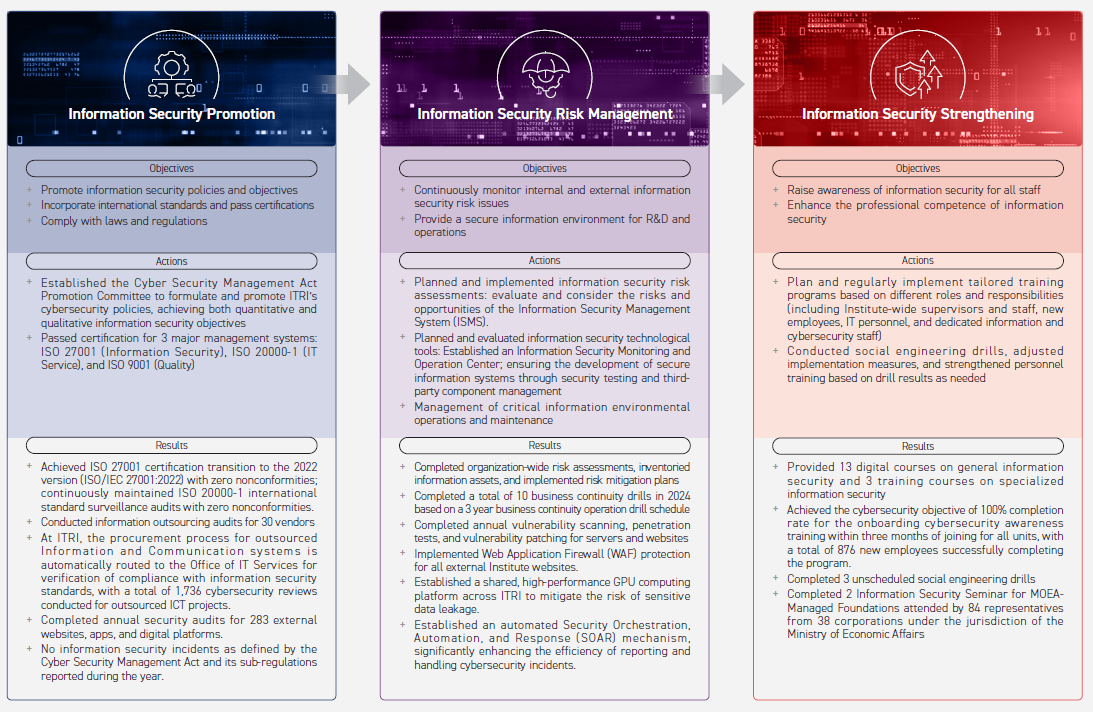
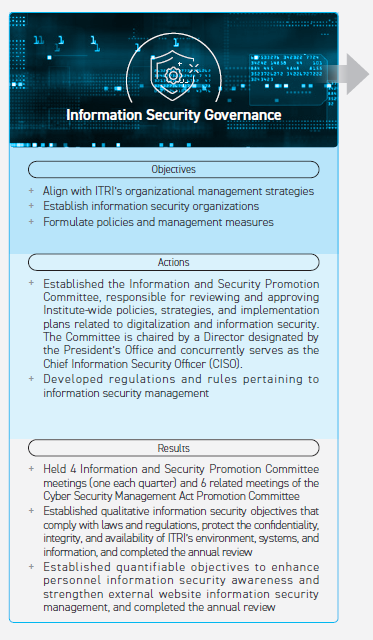
As a world-class research and development institution and an industry pioneer, ITRI places great importance on information security and confidential information management related to its technological R&D output, industry collaborations, and organizational operations. In 1999, ITRI established the Information Technology and Security Promotion Committee, with the Office of President serving as the Chair and Chief Information Security Officer (CISO). Deputy heads of various laboratories & centers serve as members, and related operations are overseen by the Office of IT Service. Through quarterly meetings, the Committee reviews and makes decisions on important IT planning and information security policies. It collaborates with various laboratories & centers to strengthen overall information security protection and management mechanisms, enhance the quality and resilience of information services, and safeguard ITRI's R&D achievements and critical outputs. In 2024, the Institute reported no cybersecurity incidents and no complaints related to personal data.

The following four development strategies ("Information Security Governance," "Information Security Promotion," "Information Security Risk Management," and "Information Security Capability Enhancement") have been outlined to safeguard ITRI's research and development outcomes and significant outputs, mitigate operational risks, and comply with regulatory requirements.

Information Security
Integrity Governance_9Integrity Governance_10

Digital Transformation

In 2024, adhering to the principles of both information security and operational efficiency, the Institute continued the digital transformation of all business processes and promoted paperless operations. Generative Artificial Intelligence (Gen AI) was leveraged to enhance operational effectiveness across research, development, and business units. The number of Institute-wide general-purpose Gen AI services increased by three compared to 2023, reaching a total of six, with over 4,000 users, reducing manpower requirements and accelerating output time. Additionally, Gen AI has been applied to optimize more than ten specific business services and tools, significantly improving work efficiency and data quality. These initiatives contribute to overall operational effectiveness while minimizing environmental impact, supporting the achievement of the Institute’s sustainability goals.

Integrity Governance_11

Grievance Management

The Institute has established multiple grievance channels and relevant regulations according to the type of business, ensuring the implementation and maintenance of a culture of integrity management.

In 2024, the Institute received a total of 14 internal and external grievances, of which two cases were substantiated: one related to noise and one to unlawful infringement. All cases were addressed in accordance with relevant management procedures. Regarding the noise grievance, the Institute carried out equipment repairs and replacements to reduce noise. For the unlawful infringement grievance, the Institute conducted organization-wide sexual harassment prevention training in 2024 to raise awareness among staff, and in the first quarter of 2025, strengthened organization-wide education and training on unlawful infringement in the workplace to proactively prevent such incidents.

2024 Grievance/Whistleblowing Cases

Integrity Governance_12

Contact Us

※ TAll fields marked with an asterisk (*) must be completed.

Please check the box to agree to the Legal Statement。

We record cookie information to provide personalized content and optimize your user experience. By continuing to browse this website, you agree to our use of cookies. For more information on privacy protection, please refer to our Privacy Policy