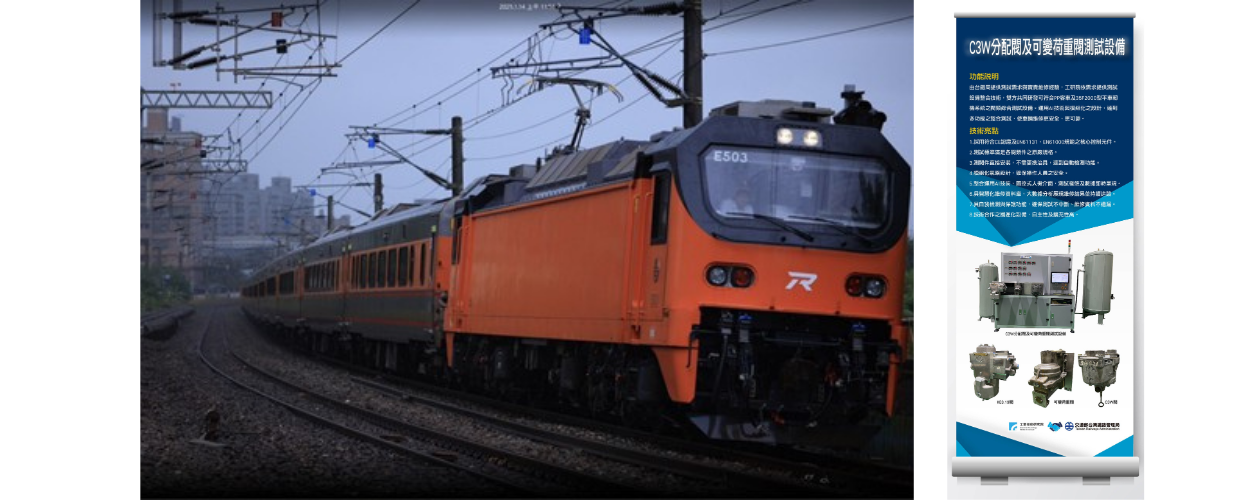
General-purpose valve testing platform enhances maintenance efficiency and safety, promoting the localization of railway equipment and industrial upgrading.
|
Environmental (E)
|
Social (S)
|
Economic (E)
|
|
Previously, a valve function test was only applicable to one type of testing platform. The universal valve testing platform can simultaneously accommodate multiple different types of test valves, enhancing the testing capacity of the platform and reducing energy consumption
|
Solving the problem of shortage of maintenance personnel at the locomotive depot and the issues related to reliability tests, enhancing the resilience of railway maintenance and improving passenger safety
|
Establishing a resilient railway operation and maintenance system, promoting the upgrading of the domestic railway equipment industry, developing localized products, resolving the dilemma of long-term reliance on foreign imports, and thus entering the international market with competitiveness
|
|
Solutions
|
Rail transit operators have long relied on imported equipment, which does not meet on-site maintenance requirements and has consequently been neglected. The Institute has developed a domestically produced valve testing platform capable of simultaneously installing valves of different specifications on a single testing platform. This platform features an automatic airway switching design that replaces the traditional manual switching and installation process. Meanwhile, it is equipped with a self-diagnostic function that enables operators to quickly identify and resolve faults, significantly reducing maintenance costs. This provides the rail industry with a high-performance testing platform solution.
|
|
Technology Application
|
² Adoption of core control components that comply with CE certification and EN61131 and EN61000 standards
² The testing standards meet the original manufacturer specifications for all types of valves.
² Integrating AI technology with a graphical human-machine interface, enabling real-time presentation of test patterns and data.
² Equipped with a smart maintenance database, big data analysis demonstrates maintenance outcomes and enables continuous tracking.
² Customized services (functional specification planning).
² Assisting clients with testing and verification, as well as on-site equipment installation and calibration.
² Domestic equipment developed through technical cooperation exhibits high autonomy and scalability.
|
|
Achievements
|
² The Taiwan Railway Corporation provided testing requirements and valuable maintenance experience, while ITRI supplied testing equipment integration technology based on these requirements. Both parties jointly developed comprehensive valve testing equipment that meets the standards for PP passenger cars and the 35F2000 flatbed brake system. By utilizing AI technology and modular design, we achieve integrated multifunctional testing, making vehicle maintenance safer and more reliable.
|