Green Campus

Release date:2025-02-13

Greenhouse Gas Inventory

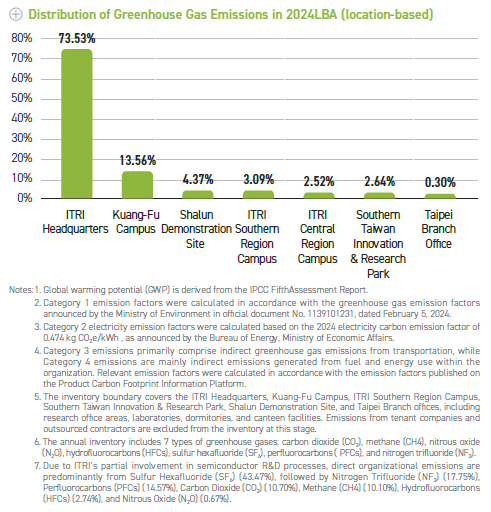
ITRI is committed to practicing sustainable management. Since 2022, the Institute has independently conducted organization-level GHG emissions inventories following the ISO 14064-1:2018 standard, using the "Operational Control Approach" as the basis to systematically quantify GHG emissions from various operational activities, ensuring that the inventory results meet international standards. In line with carbon-reduction pathway planning, the organizational scope consistent with this report was confirmed in 2024, with 2020 set as the base year, and the same calculation methodology applied to complete the inventories for all years.


The 2024 inventory covers the ITRI Headquarters, Kuang-Fu Campus, ITRI Southern Region Campus, ITRI Central Region Campus, Southern Taiwan Innovation & Research Park, Shalun Green Energy Technology Demonstration Site, and the Taipei Branch. Following verification by BSI (British Standards Institution Taiwan) in accordance with ISO 14064-1:2018 guidelines, the Institute’s total GHG emissions were 68,886.311 metric tons of CO2e, with purchased electricity accounting for 68.04% of total emissions, representing the primary emission source. To identify high-carbon hotspots, ITRI has established an enterprise-wide GHG inventory system that integrates data analysis to precisely plan carbon-reduction measures.


Total Greenhouse Gas Emissions in 2024

Category

Amount of GHG Emissions- LBA (location-based) (metric tons CO2e)

Amount of GHG Emissions- LBA (location-based) (metric tons CO2e)

GHG Emission Intensity-LBA (location-based) (metric tons CO2e/NT$ million)

Category 1

5,871.3941

0.19

Category 2

46,870.1851

47,583.6907

1.49

Other Category

16,144.7314

0.51

Total

68,886.311

69,599.816

2.19


1

iTree Tree Database

ITRI is committed to preserving biodiversity and fostering an eco-friendly environment across its campuses through various greening and environmental management initiatives. Since 2023, the Institute has established the "iTree Tree Database," regularly conducting tree risk assessments, updating records, and installing tree nameplates. Maintenance staff and employees can scan the nameplates to monitor tree health in real time. In 2024, ITRI further implemented a "Tree Health Assessment" program, establishing standard procedures for tree assessment and removal of diseased trees, ensuring proper care, reducing the risk of collapse, and enhancing the long-term carbon-reduction benefits of campus greening.

tree

OMEGA ZONE Zero-Carbon Buildings

OMEGA ZONE Zero-Carbon Buildings

Campus Greening

3

4

Energy-Efficient Buildings

Through the transformation of existing buildings and the construction of green buildings, the Institute demonstrates its commitment to low-carbon operations. As of the publication of this report, the Institute has cumulatively obtained eight Green Building Labeling System of EEWH and two Intelligent Building Label certifications, including the successful retrofit of one existing building to Diamond-level Green Building standards. In 2024, the ITRI Central Region Campus achieved Near-Zero Carbon Building certification, underscoring the Institute’s continuous efforts in "building energy efficiency'' and establishing a benchmark for sustainable architecture within the organization.


Central Taiwan Innovation Campus Achieves Level 1+ Energy Efficiency Certification 


Energy Saving Achievements

Compared with the base year (2020), the Campus achieved annual electricity savings of over 116,300 kWh, equivalent to 13.21% of total electricity consumption.

Renewable Energy

Water Stewardship

The Campus has installed a total 150 kW photovoltaic system, generating 201,100 kWh in 2023, which met 22.85% of the electricity demand for public areas. In 2024, renewable energy generation reached 211,500 kWh

A rainwater harvesting system has also been implemented. In 2023, 9,375 m3 of rainwater was collected and used, accounting for 49.14% of the annual total water consumption. In 2024, rainwater utilization reached 5,194 m3, representing 41.56% of the total annual water consumption

4

Contact Us

※ TAll fields marked with an asterisk (*) must be completed.

Please check the box to agree to the Legal Statement。

We record cookie information to provide personalized content and optimize your user experience. By continuing to browse this website, you agree to our use of cookies. For more information on privacy protection, please refer to our Privacy Policy