Social Benefits

Release date:2025-12-17

Making Taiwan a Better Place through Public Services that Involve Technology

ITRI established the Public Welfare Committee in 2011 with the sustainable vision of “Making Taiwan a better place through public services that involve technology”. In addition to promoting industrial developments, ITRI also strives to exercise its CSR, care for communities, and enhance contributions to social welfare. Through various aspects such as technology application and services, technology education promotion, corporate volunteering, and urban-rural technology outreach, ITRI integrates core technological research achievements, technological knowledge, and the energy of corporate volunteers. Moreover, surplus funds are allocated to support public services each year, addressing issues related to emergency relief, public safety and care for the underprivileged. ITRI actively spreads this philosophy to industry, aiming to encourage more companies to join efforts in fulfilling the social responsibility of the technology sector.

Social Welfare Strategy & Roadmap

ITRI has been consistent in its promotion of a public welfare technology platform, leveraging its technological expertise to engage in social benefits initiatives. This aligns with ITRI's mission of "using technological R&D to drive industry development, create economic value, and enhance social benefits." By extending research outcomes to social benefits, ITRI consolidates internal and external resources, focusing on youth development, rural education, regional revitalization, and environmental conservation. Furthermore, ITRI demonstrates concern for underprivileged groups and communities, utilizing technological value to lay a solid foundation for improving the social environment. Leveraging technological applications as a soft power to foster collective efforts in enhancing social benefits, we utilize social benefits service platforms to connect social welfare organizations, corporate partners, and government agencies, thereby ensuring that all participating groups and individuals benefit meaningfully.

Social Benefits_21

LBG Analysis

To ensure the effective and ongoing management of social engagement activities, ITRI has adopted the Impact principles of the London Benchmark Group (LBG) as a framework for decision-making and planning. This approach aims to generate greater public benefit value, foster a people-oriented organizational culture, and contribute to the development of practical technologies and products that align with human needs. Moving forward, ITRI will actively engage with government agencies, corporate partners, and social welfare organizations worldwide to make the world a better place and uphold the belief in creating valuable public welfare.

Social Benefits_22

Technology Application

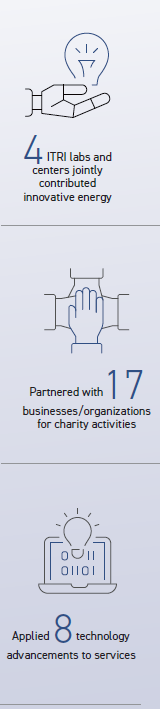
The ITRI Public Welfare Committee, established in 2011, integrates innovative technology with social welfare initiatives to infuse humanistic care, providing disadvantaged groups with new tools and perspectives to improve their lives and transform their futures.


Due to the high salt content, marine debris is unsuitable for direct incineration. In collaboration with National Dong Hwa University, ITRI applies high-temperature gasification technology to convert marine debris into biochar, which is then fabricated into artificial reefs (carbon-negative fish reefs). Once deployed in the ocean, these reefs sequester carbon while promoting the growth of corals and seagrass, achieving circular utilization of marine debris and contributing to a sustainable environment.

The Carpenter's House Welfare Association has introduced automated disinfection robots, marking the first application in a charity second-hand store. This innovation reduces the burden of disinfection, enhances operational efficiency, and allows staff to focus on creativity and service, demonstrating a new trend for public welfare stores.

An AI-powered ''Music-Synchronized Interactive Training System'' has been developed and integrated into welfare programs at long-term care locations in Hualien, benefiting hundreds of disadvantaged elderly individuals. This system improves the quality of music therapy and overall well-being. This innovative model aligns with health, inequality reduction, and sustainable cities and community goals, supporting both elderly and children in psychological and cognitive enhancement.


ITRI continues to leverage its unique technology and innovation to contribute to society, playing the role of a public welfare platform. By using charitable technology to match resources with the needs of marginalized groups in remote areas, ITRI aids in solving urgent relief problems and promotes social and environmental protection. These efforts ignite small but meaningful initiatives that collectively shine as beacons of hope across local communities. 
Social Benefits_23

Technology Education

ITRI, recognized as Taiwan’s leading hub for technological research and development, understands that ''technological talent'' is key to sustainable operations. While promoting technology education, the Institute places particular emphasis on supporting disadvantaged students, aiming to narrow the educational resource gap between urban and rural areas and to help children overcome the limitations of their environments, enabling them to explore a broader range of life possibilities.


By integrating sustainability with education, ITRI offers diverse technology courses that introduce children to the importance of net-zero goals and teach them how to practice green principles in daily life. To make the learning process inspiring and engaging, institute volunteers meticulously design a variety of Fun Technology Camps, including drone exploration, 3D printing experiences, and renewable energy technology camps. These "hands-on" activities allow children in remote areas to learn scientific knowledge and skills through hands-on activities, sparking their interest in learning and opening up new possibilities for their future.

Social Benefits_24

Corporate Volunteers

The ITRI Public Welfare Committee, grounded in professionalism and passion, mobilizes all employees to participate in the ''Clubs and Us – Public Service Program'' initiative. By integrating internal clubs, departmental centers, and external NGOs, the program engages stakeholders in promoting diverse philanthropic activities, demonstrating the depth and breadth of corporate social responsibility.


The activities are varied and impactful. These include charity sales of mandarins, noodles, and ice cream, with proceeds donated to social welfare organizations; refurbishing decommissioned computers into recycled devices for donation to remote communities; organizing museum explorations and floral art events for visually impaired individuals to experience the power of beauty; and the Tminun Workshop project, which provides skill training and collects second-hand clothing to support young mothers in practicing circular economy principles and achieving independent living.


These initiatives not only reduce environmental impact and align with global net-zero carbon trends but also promote resource recycling and the circulation of goodwill. Employees are fully engaged from conceptualization to execution, leveraging creativity and action to inspire broader corporate and societal participation. Each act of kindness accumulates into a wave of impact, conveying the belief that ''the depth of love determines the magnitude of willingness to give.''

Social Benefits_25

Urban-Rural Technology Outreach

ITRI leverages its operational bases in central and southern Taiwan, as well as Hualien-Taitung areas, to serve the surrounding neighborhoods and communities. By combining local technical unit resources and volunteer groups, ITRI focuses on charitable visits, urban-rural technology outreach, and revitalizing tribal communities as its main promotional axes, providing long-term care and services to local disadvantaged groups.


ITRI promotes material science, agricultural engineering, and processing technologies. For example, by combining 3D printing, technology experiences, and agricultural application techniques with local characteristics, ITRI was able to extend a hand to remote areas and indigenous tribes, helping to root science and technology education and provide local and rural charitable services. ITRI's charitable footprint also extends to remote islands and deep mountains, mainly focusing on local youth, raising the industrial application value of community tribes. In particular, ITRI offers guidance and assistance in economic revitalization to improve living conditions, implement local identity, and ensure the continuity of public welfare values without interruption.

Social Benefits_26

Contact Us

※ TAll fields marked with an asterisk (*) must be completed.

Please check the box to agree to the Legal Statement。

We record cookie information to provide personalized content and optimize your user experience. By continuing to browse this website, you agree to our use of cookies. For more information on privacy protection, please refer to our Privacy Policy